

HOW DID THEY DO IT? HOW WERE THREE THOUSAND BAPTIZED IN ANCIENT JERUSALEM?

Was it even possible? According to the book of Acts, three thousand were baptized in Jerusalem in just one day. And yet, baptisteries did not exist during the time of Jesus. Or…did they?
Naturally, the New Testament does not require a specially constructed baptistery to fulfill the command to be baptized. But in Jerusalem, a place high in elevation and so far away from a river, how was it possible for so many to be immersed?
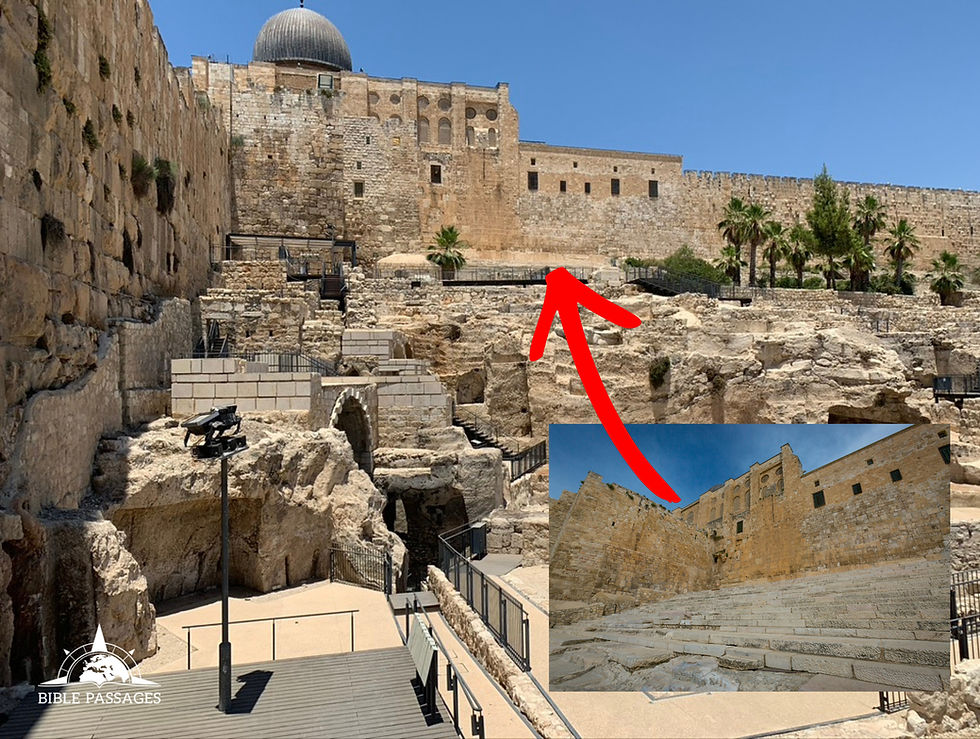
The answer: in the many mikva’ot (Jewish ritual baths) located throughout the city, many of which were located near the southern steps of the Temple Mount.
Religious purification by water played an important role in biblical Judaism, and by the first and second centuries B.C., the process of full-body immersion had become a standard practice. On regular occasions, and especially before entering the temple in Jerusalem, Jewish devotees would often ritualistically immerse themselves in a mikveh (singular for mikva’ot) and by the time of Jesus, mikva’ot were being constructed all over Israel.

I have personally observed their existence in several places in the regions of Galilee, the Shephelah, and the desert of Judea. The first photo in my article was taken in Jerusalem near the southwest corner of the Temple Mount in Jerusalem and shows that they were likewise found in Jerusalem.
Archaeologist Ronny Reich says that approximately 150 mikva’ot have been discovered in Jerusalem, with about 60 located in the upper city and about 40 near the southern gates of the Temple Mount (Reich, 52).
In 2011, a conservation project was undertaken to preserve and showcase these pools, and today visitors can see many of these mikva’ot in what has become known as the Ritual Baths Trail (emekshaveh). Even more have been discovered since 2011, and one as recently as December of 2025 (see Israel Antiquities Authority, December 2025).
Water for these reservoirs came from runoff in the Bethesda Valley and from collection pools southwest of Bethlehem at a place known today as Solomon’s Pools. Built during the Hasmonean period (141-37 BC), water from these pools was siphoned through pipes and aqueducts and into underground cisterns.

During the 19th century, explorer Edward Robinson discovered and surveyed some 49 water reservoirs underneath and near the Temple Mount, most of which date to the second temple period. These sources, in addition to the pool of Siloam in the central valley, provided an abundance of water to citizens of Jerusalem and would likewise sustain both the needs of the Temple and those needed in ritualistic cleansing within the many mikva’ot.

To be baptized into Christ (Galatians 3:27), all that is needed is enough water to immerse. Thus, the ancient mikva’ot in Jerusalem would have provided ample space for two individuals to enter the baptistery and for one to baptize the other (cf. Acts 8:38).
Any river, water reservoir, or body of water would typically be large enough “to bury” someone in water (see Colossians 2:10; Romans 6:1-5) but the sheer volume of mikva’ot available in Jerusalem would have made the task of baptizing 3,000 people convenient and manageable.
The abundant supply of water and places to baptize in Jerusalem is but another example of the connection between faith and fact in the land of the Bible.
By John W. Moore
Sources
*IAA - https://www.iaa.org.il/en/page/news-index (See “Ahead of the Tenth of Tevet: A Mikveh (Ritual Purification Bath) from the Final Days of the Second Temple Period Discovered in Archaeological Excavations beneath the Western Wall Plaza” [December 29, 2025])
*Reich, Ronny. “The Great Mikveh Debate,” Biblical Archaeology Review 19.2 (1993): 52–53.
*"The Incredible History of the Jewish Temple?" a Bible Passages Documentary by John W. Moore. https://www.youtube.com/@biblepassagesministry
Everything we write or produce is available for free because of the generosity of our partners. We would be so greatful if you could join us in the mission. https://www.biblepassages.net/give


Comments