

What Can You Learn From the Desert?
Has this ever happened to you? You are reading a text in the Bible, and you read about a wilderness (or desert), and you just assume it's always talking about the same one. Would it surprise you to know there are actually three wildernesses in the proper boundary of Israel (not to mention the ones that are mentioned outside of the traditional boundary of Canaan)? In this article, we will examine three of the main wildernesses in the Bible. What happened in each? What can each teach us about God and how he wants us to live?

First, let's give names to the three wildernesses and briefly discuss the geography. Jerusalem can be our anchor point, and we will primarily discuss the land of Judah. Jerusalem sits in the Judean Hills (or hill country). As you move out of that hill country, you encounter wildernesses both south and east.

The Judean Wilderness
The Judean wilderness lies just east of Jerusalem. And when I say just, I mean just. Not 1 mile as the crow flies on the other side of the Mount of Olives, the rain shadow from the hill country means that this geologically distinct area receives almost no rainfall. This desert area covers everything west of Jerusalem to the Rift Valley (Jordan River/Dead Sea).
The Negev(s)
The second and third wildernesses are geologically identical and thus only separated by their functions and roles to the people who live there. The Negev (or Negeb) is made up of a very poor soil known as loess (pronounced lo-ess). It is divided into two sections: the Biblical Negev and the Greater Negev.
The Biblical Negev is only 5-10 miles wide in many places and is distinct because it is, to a degree, an area of settlement. It serves as a boundary between other regions and the Greater Negev, but it remains connected to the more settled areas through its northern border.
The Greater Negev, on the other hand, is almost completely removed from civilization. There is a depression that may allow travel, but instead of true settlement, it is marked more by outposts and way stations.
Now that we understand a little bit more about these areas, why does it matter? What are some significant events that happened in each, and how can we build our faith from an understanding of the land? I want to discuss three things we can read in the biblical text as illustrations for each area.
The Greater Negev - The Place We Need to Conquer
First, in the Greater Negev, we have the Solomonic outposts. Solomon represented the height of royal power in Israel. His kingdom's borders extended farther than those of any other king. In 1 Kings 9, the text gives a summary of his building projects and accomplishments, and in verse 18 it says he built Baalath and Tamar in the wilderness in the Land of Judah. There have been many archaeological digs and speculations about how many places Solomon may have built in the wilderness, but I want to consider, for a moment, a deeper question. Why would he be interested in building out here?
The religious landscape can be imposing at times; it's frightening to put ourselves out there
Solomon was intentional about building in the wilderness because it was, in part, a show of the greatness of his kingdom. He conquered new territories, established new cities, and built new watchtowers. As he had the ability, he wanted to put Israel on the map, so to speak, and expand, ultimately taking as much of the land as he could. As a faith lesson, I want you to consider that this is an area where American Christians have lost our way. If we use the Greater Negev as an analogy for the frontier that needs to be conquered, the idea is that we ultimately need to go into those places to set up outposts and start expanding our influence. In our culture and context, this is just an expression of the Great Commission, but the questions have to be asked: Where are the frontiers? Who is going? Do we identify as a Solomonic kingdom - expanding, growing, evangelizing? Or do we identify as a kingdom of one of the other kings, shrinking, defending, and retreating?
There is no doubt that the Greater Negev is an imposing force of nature. With little water, heat, and no modern comforts, the task of building there must have seemed almost ludicrous at first. The same could be said about our situation. The religious landscape can be imposing at times; it's frightening to put ourselves out there, but if we remember these outposts in the wilderness, we too can begin again, expanding our frontiers.
The Biblical Negev - The Place We Cannot Stay
The second wilderness moving towards Jerusalem from the south is the Biblical Negev. I already mentioned it is not distinct in its geography but rather in its use. The best illustration of that is Abraham, who settled in Beersheba on the border of the Biblical Negev. Abraham seems to be moving through the land of Canaan from North to South, and that journey has not been without conflict. His wealth is a massive drain on resources, and if this traveling city happens to plop down in your watershed, you might not have enough water. Abraham seems to have settled in Beersheba, perhaps in part, because it was a place he could be without conflict. Beersheba was a place with water and on a trade route, but was remote and removed from the core of society.
As we think about a modern analogy to the Biblical Negev, I want to bring up a trend I have both seen in others and experienced in myself. Many Christians, appropriately, hate what is happening to our culture and our society. Seemingly, we are embattled and losing the culture war on many fronts. Between secularism and materialism, to LGBTQ issues and school curricula, we have found ourselves, much like Abraham, as foreigners in a land of idolatry. The trend that needs to be addressed, however, is that we sometimes want to run away. I don't mean run away in a cowardly sense, but more in a monastic sense.
We cannot raise our children in a bubble of ignorance, blissfully incapable of dealing with any hardship
As conflict grows, there is a natural tendency to retreat - look for our Biblical Negev. We want to remove ourselves from the fray, shield our children from any harmful influence, and live conflict-free away from this sinful world. The faith lesson from this analogy is that the Biblical Negev is a place we cannot stay. Abraham ultimately settled in Beersheba, but it was never God's intention for him to stay there and raise up the Hebrews from within Canaan. God sent Abraham’s descendants to Egypt to become strong and ultimately demonstrate his power.
Similarly, we must fight the urge to settle in our conflict-free zone. Our permanent home is not in this world, so we are not supposed to settle here anyway. We cannot retreat to the wilderness, or the mountains, or the plains, where there is no one to convert. We cannot raise our children in a bubble of ignorance, blissfully incapable of dealing with any hardship. We cannot write off society with statements such as "I hate people" or live the rest of our lives in a walled compound (as nice as that sometimes sounds!). Like Abraham, there may be seasons in our lives where these things are appropriate, but the lesson from the Biblical Negev is that we cannot stay.

The Judean Wilderness - The Place We Need Close By
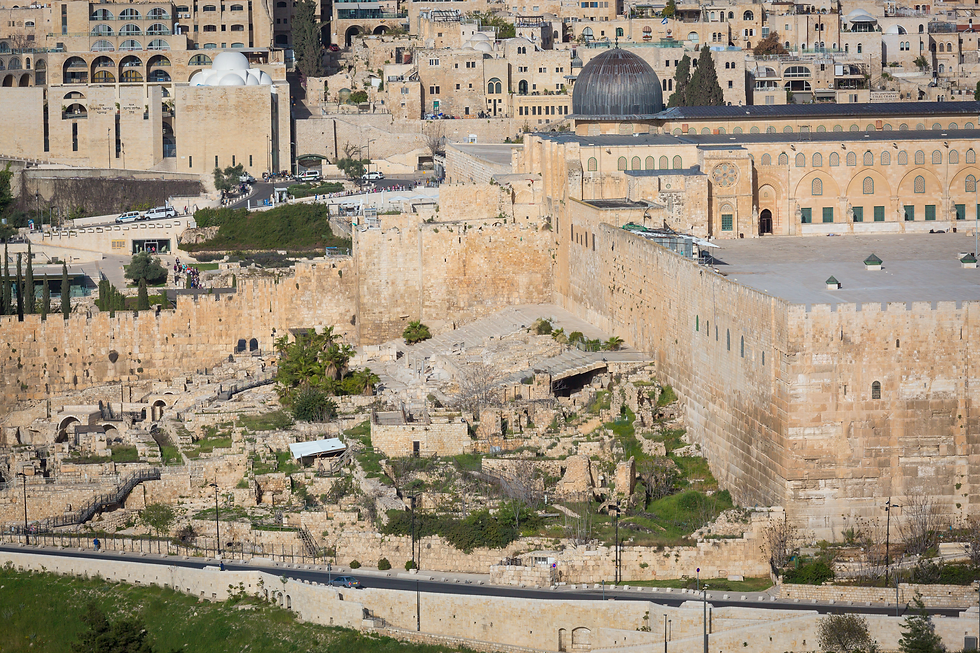
That brings us to the Judean Wilderness. I mentioned it already, but what really struck me about this particular wilderness is how close in proximity it is to Jerusalem. It is quite literally just over the ridge. It is safe to say that most of the wilderness events recorded in the biblical text occur here. It is where David fled from Saul, the road from Jericho to Jerusalem, the gateway of the conquest, and host to many other events.
While lessons can be drawn from any of these points, I want to focus on the role of the wilderness during the time of the kings of Judah. For those kings, this wilderness was the escape hatch. David, during the United Kingdom, demonstrated the path that many of his successors would follow when trouble arose. When Absalom mounted his coup and marched on his father's kingdom, David was forced to flee. Although it had been many years, the way was not unfamiliar to him. The text says that David fled across the Kidron, ascended the Mount of Olives, and retreated into the wilderness. From that point on in history, when a king of Judah got in trouble, if they could escape, that is the way they chose.
What then is the lesson from this wilderness? Sometimes we need a wilderness close by. I have argued that we cannot retreat and remain in the Biblical Negev removed from society, but sometimes we need a place to retreat, recenter, and struggle with God. The Bible does not always specify which wilderness, but Jesus constantly retreats to desolate places to pray. We, too, cannot live our whole lives in constant tension and conflict. Sometimes, we need a wilderness that is close by where we can retreat for a season. This may be a place in your house, a nearby park or mountain, or even a local coffee shop or library. Whatever it is, the Judean wilderness is our escape. Escape, however, has to have a purpose.
Jesus, receiving his answer from the Father, knows that it would be a disobedient, cowardly retreat to avoid the coming mob. He knows that it would abandon humanity to hopelessness. He knows what he has to do.
I want you to consider Jesus again. He demonstrates what it means to be human by escaping to the wilderness. He presumably used that time to rest and relax, but he also used it to pray. He did not use it as a place to avoid his mission. To illustrate this point, I want to paint a picture of one of the most powerful choices in history.
The night is dark, and the apostles are sleeping. Jesus, pleading his heart to the Father, knows what is coming. At this very moment, soldiers and enemies are crossing the Kidron Valley and closing in on the garden at the foot of the Mount of Olives. Jesus has a decision to make. He is well aware of where he is. Not the garden per se, but on a road - the road of the king's retreat. David, his father, paved the way; David’s sons, Jesus' forefathers on this earth, followed suit. When the pressure is rising and the opposition is approaching, good kings and bad kings alike walk over the mountain and disappear into the wilderness to fight another day. But that is not what happens this time.
Jesus, receiving his answer from the Father, knows that it would be a disobedient, cowardly retreat to avoid the coming mob. He knows that it would abandon humanity to hopelessness. He knows what he has to do. With the escape route so tantalizingly close, he denies himself and submits to the will of the father.

Conclusion
Wilderness theology is a rich and rewarding study. The geography - how people used the land to survive, thrive, and interact with their world has an impact on us. The wilderness is formative, transformational, peaceful, harsh, and inhospitable all in one. We need it in our lives: a place to conquer, a place to rest for a season, and a place to retreat to pray. Hopefully, when you read the Bible from now on, your eyes won't skip over the wilderness, but you will take time to pause, reflect, and ask yourself, "How is this shaping me?"


Comments